
Aerobic & Anaerobic Training
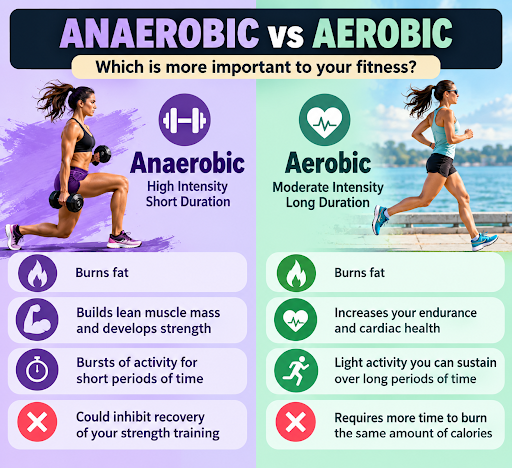
Whether you’re a beginner, a recreational athlete, or training for your next big race, understanding aerobic and anaerobic energy systems can completely change the way you think about exercise.
They may sound complicated, but the basic idea is simple: your body has different ways of producing energy depending on how hard and how long you exercise.
The Aerobic System: Your Endurance Engine
“Aerobic” means with oxygen. Your aerobic system uses oxygen to help your body produce energy, primarily from carbohydrates and fat.
This system is relatively slower at producing energy, but it is incredibly efficient and sustainable. That makes it essential for activities that last several minutes, hours, or even longer.
Think about:
Easy running or cycling
Hiking
Swimming continuously
Long-distance running
A long bike ride
When you’re exercising aerobically, your breathing and heart rate are elevated, but the effort is generally sustainable. You can keep going for a long time.
For endurance athletes, developing a strong aerobic system is the foundation of performance.
The Anaerobic System: Your High-Power Engine
“Anaerobic” refers to energy production that does not rely primarily on oxygen. This system allows your body to produce energy very quickly, which is especially important when intensity becomes very high.
Think about:
A sprint
Running up a steep hill
A hard bike interval
Jumping
A short, powerful effort at the end of a race
The trade-off is that this high-power energy production cannot be sustained for nearly as long as aerobic energy production.
The Most Important Part: They Overlap
Here’s where many people get confused: you are never simply “aerobic” or “anaerobic.”
Both systems are working at the same time.
During an easy jog, your aerobic system provides most of the energy. As you increase the intensity, your anaerobic contribution gradually increases. By the time you’re doing very intense intervals or sprinting, the anaerobic contribution becomes much greater.
For example, Zone 3 is still predominantly aerobic, while Zone 4 involves a much greater anaerobic contribution. VO₂ max training is extremely demanding on the aerobic system, but it also involves a substantial anaerobic contribution.
It’s more accurate to think of the two systems as two engines working together, rather than two switches that turn on and off.
Why Does Knowing the Difference Matter?
Understanding these systems helps you train with a purpose.
If you only train hard, you may improve your ability to produce high-intensity power but neglect your endurance foundation. If you only train easy, you may develop excellent endurance but leave speed and high-intensity performance on the table.
A balanced program uses both.
Easy and longer sessions build your aerobic foundation.
Intervals, hills, tempo work, and sprints challenge your higher-intensity systems.
A Simple Tip
Don’t judge every workout by how exhausted you feel.
A successful endurance program isn’t about making every workout brutally hard. Easy days should actually be easy, and hard days should have a specific purpose.
Your body is remarkably adaptable. Give it the right type of stress, enough recovery, and consistency; and both energy systems can become stronger.
Aerobic gives you the ability to keep going.
Anaerobic gives you the ability to go harder when you need it.
Together, they make you a more capable athlete.
